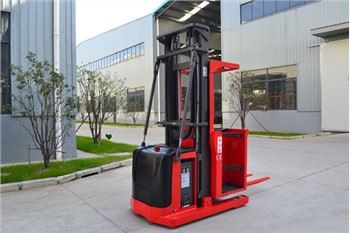
If you've ever walked through a busy warehouse or distribution center, you've probably noticed that most goods are stacked in neat, gridlike rows-each pallet aligned so every fork, every shelf, and every inch of floor space fits perfectly. But what if your operation works in a space that's not so grid-friendly? What if you need to stack goods in a circular pattern, maybe around a central support pillar, in a mezzanine's curved storage area, or in a small, oddly shaped bay where straight rows just don't make sense? For years, many in the material handling industry assumed sit-type electric reach trucks weren't built for that. As a supplier of sit-down electric reach equipment, I've gotten this question more times than I can count: "Can a sit-type electric reach truck actually be used for stacking goods in a circular pattern?"
The short answer is yes-but it's not just a flat "yes." It depends on two big things: what your circular stacking needs look like, and whether your reach truck is set up (and operated) to make tight, controlled turns without sacrificing safety, load stability, or efficiency. Let's break this down, because this question isn't just a technical one-it's about solving a real space problem many operations face.
First, let's get clear on what "circular stacking" actually means for material handling. It's not just stacking pallets in a circle on the floor (that's easy with a basic pallet jack). It's stacking palletized goods on vertical racks arranged in a curve, whether around a central column, along the curved wall of a storage bay, or in a semi-circular mezzanine that wasn't designed for straight racking. The key challenge here is turning radius. Standard sit-type electric reach trucks are built for narrow aisles, but their ability to pivot, turn, and align forks in a tight, curved path varies a lot by model.
I learned this firsthand a few years back, when a client that ran a specialty wine storage facility reached out to us. Their space was built in a half-circle around a central structural pillar-every rack had to follow that curve, and they needed to stack full wine pallets (each weighing around 1,500 kg, perfect for a 1.5ton capacity truck) in that curved layout. They'd been renting different types of lift trucks for months: stand-up reach trucks that were too unstable for their heavy wine loads, rough terrain forklifts that were too wide for their aisle widths, and even manual pallet jacks that required two people to move a single load. They were wasting time, damaging pallets, and running over their rental budget.

We sent our team to assess their space, and first, we walked through their current bottlenecks. Their aisles were only 2.1 meters wide-way too tight for most standard forklifts, and even many reach trucks. Then we looked at the type of work they were doing: stacking pallets at heights up to 5 meters, so they needed a reach truck with good lifting capacity and mast flexibility. The model we recommended to them? Our 1.5ton Semi Electric Pallet Truck With Sprocket Rotation-and that sprocket rotation feature ended up being the secret sauce for their circular stacking.
Wait, let's back up. Most people don't think about sprocket rotation when they're talking about reach trucks, but that small part changes everything for tight turns. On standard reach trucks, the forks and mast extend forward, and the truck's front wheels pivot to turn. But when you're working a curved rack, you don't just need to turn left or right-you need to adjust the angle of the forks as you move along the curve to align perfectly with each rack level. The sprocket rotation on our 1.5ton Semi Electric Pallet Truck With Sprocket Rotation lets the fork assembly rotate smoothly, independent of the truck's body. So when the operator drives along the curve, they don't have to yank the steering wheel to make a sharp turn-they can adjust the fork angle in small, precise increments to line up with the curved rack slots. That's not possible on many basic stand-up trucks, which only have fixed fork alignment.
But sprocket rotation alone isn't enough. The truck also needs a tight turning radius. Let's compare: a typical sit-down electric reach truck has a turning radius of around 1.8 to 2.2 meters. That's small enough for narrow aisles, but when you're working a curved path, you need even tighter control. Our 2ton 4.5 Meter Sit High Electric Reach Forklift, for example, has a turning radius of just 1.9 meters-perfect for the 2.1-meter aishes our wine client had. But we also made sure to point out that their model's stability features were non-negotiable here. When you're stacking in a curve, the truck's center of gravity shifts a little with every turn, especially when you're lifting heavy pallets 4.5 meters high. That's why all our SIT DOWN ELECTRIC FORKLIFT models, including the one we suggested to our wine client, have a low center of gravity design and optional load stabilizer systems. For their 1.5ton wine pallets, that meant no risk of tipping when turning along the curve, even at full lift height.

Another big factor: battery life. Circular stacking means operators might be making more small turns, more adjustments, and more trips around the curved rack than they would in straight aisles. If the battery runs out mid-shift, that's downtime. That's why for operations that do a lot of curved stacking, we always recommend our Electric Reach Truck with Italy FAAM Battery. The FAAM battery has a longer cycle life-we've found it lasts up to 20% longer than standard lead-acid batteries, even with the extra movement and adjustments from curved stacking. For our wine client, that meant they didn't have to mid-shift battery swaps, which cut their total operating time by almost 15% in the first month they used the truck.
But here's the catch: a sit-type electric reach truck can work for circular stacking, but it's not a one-size-fits-all solution. We've had clients come to us asking to use a standard sit-down forklift meant for straight aisles to stack in a circular pattern, and that rarely works. The key variables to assess before you make a decision are:
First, your aisle width and curve radius. If your aisles are wider than 2.5 meters, you have more flexibility, but if they're under 2.2 meters, you need a truck with a turning radius of 2 meters or less. The curve itself also matters: a sharper curve (smaller radius) will require more precise fork rotation, so a model with sprocket rotation is a must. Our wine client's curve had a radius of 3 meters, which is perfect for the model we recommended, but if your curve is even tighter, you might need a specialized variant with even more rotation control.
Second, your load size and weight. Circular stacking usually involves pallets that fit standard dimensions, but if you're using oversized pallets, you need to make sure the truck's fork width and length are adjustable to fit, so they don't stick out when turning. Our 24V Quality Guarantee Electric Reach Truck Forklift has adjustable fork tines that can be modified to fit most non-standard pallet sizes, which is a big plus for operations that handle specialty goods.
Third, operator training. This is the part that most people miss. Even the best truck won't work if the operator isn't trained to handle curved stacking. When you're working around a curve, you can't just rely on straight-line alignment-you have to predict how the truck will turn, adjust the fork angle in real time, and make sure the load is centered as you move. We worked with our wine client to do one-on-one operator training, and within a week, their team was as efficient with the curved rack as they'd been with straight racks using their old equipment. Training takes 2 to 3 days, but it's worth it to avoid collisions, damaged pallets, and lost time.
Let's circle back to that wine client, because it's a perfect example of what works. After switching to our 1.5ton Semi Electric Pallet Truck With Sprocket Rotation with the FAAM battery, they reported a 25% reduction in pallet damage, a 30% increase in daily stacking capacity, and they didn't have to rent any more temporary lift equipment. The curved rack arrangement they needed to use wasn't an obstacle-it was a space their operation had, and the right sit-type electric reach truck made that space work efficiently, safely, and cost-effectively.
I know some of you might still be thinking, "What if my operation is different? What if I'm stacking lighter loads, or in a larger curve, or in a space that's not a half-circle?" The same principles apply. The core of it is choosing a sit-type electric reach truck with the right turning radius, fork rotation capability, and stability features to match your specific curve and load requirements. You don't need a special "curved stacking only" truck-you just need a standard model that's configured to handle the unique movement demands of a curved path.

If you're currently struggling with space that requires circular stacking, or if you're looking to optimize your operation by using unused curved space in your warehouse, the next step is to figure out exactly what your requirements are. We can help: our team will come assess your space, measure your aisles and curve radius, look at your load weights and sizes, and recommend the right sit-type electric reach truck to fit your needs. No generic solutions, no pushy sales pitches-just equipment that solves your specific problem.
Ready to stop letting curved or irregular space go unused, and start stacking efficiently? Contact our team to discuss your sit-type electric reach truck needs and find the perfect fit for your circular stacking tasks.
References
- Material Handling Industry of America. (2022). Reach Truck Design and Application Guidelines for Narrow Aisle and Specialized Storage Spaces.
- FAAM Batteries. (2023). Cycle Life Performance Comparison for Electric Warehouse Vehicles.
- Warehouse Safety Council. (2021). Guidelines for Operating Lift Trucks in Curved and Irregular Aisles.