

If you've ever spent time moving pallets around a warehouse, loading docks, or retail storage spaces, you've probably relied on walkie type electric pallet stackers-those compact, maneuverable workhorses that look simple but are packed with engineering details that make or break your daily efficiency. One question I get asked more than any other, especially by first-time buyers or operations managers looking to upgrade their fleet, is: "What's the speed of the lift and lower operation for these machines?" It's not a trivial detail, either. Too slow a lift and you're falling behind on order picking schedules; too fast and you risk damaging pallets, shelving, or even injuring workers. As a supplier of walkie type electric pallet stackers, I've spent years testing these specs, troubleshooting real-world use cases, and walking customers through how to pick a machine that fits their exact workflows. Today, I'm breaking down everything you need to know about lift and lower speeds, why they matter, and how to match them to your operations.
First, let's get clear on what we're talking about when we reference lift and lower speeds for walkie type electric pallet stackers. Unlike driving speed (how fast the whole machine moves across a floor), lift speed measures how quickly the forks rise from the ground to their maximum height, while lower speed is how fast they come back down-usually loaded, since that's when the safety and performance limits matter most. These speeds aren't random numbers pulled from a spec sheet; they're calibrated to balance three core needs: productivity, safety, and component longevity. Push a stacker to lift faster than its design allows, and you'll strain the hydraulic system, overheat the motor, or even cause the forks to drop abruptly if the hydraulics can't manage the weight. Err on the side of too slow, and you'll add 30 minutes or more to a full shift of moving 100 pallets-time that adds up to lost revenue during peak seasons.
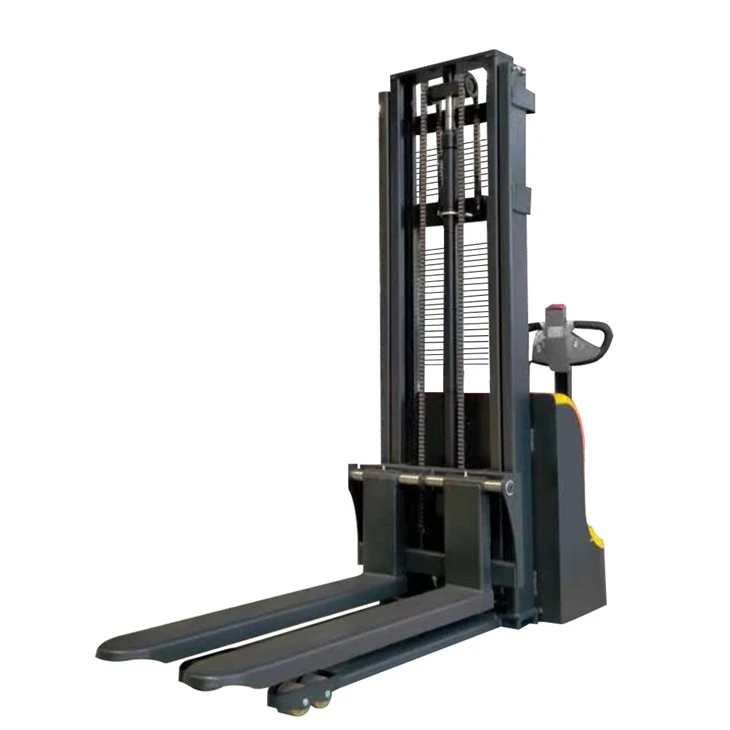
So, what's the typical range for these speeds? For most standard walkie type electric pallet stackers, you'll see rated lift speeds (with a full load, usually 1,000kg to 1,500kg, which is the most common capacity range) between 0.08 m/s and 0.15 m/s. Lower speeds, especially when loaded, are usually slightly slower to ensure control-most models fall between 0.10 m/s and 0.18 m/s, with many manufacturers setting automatic speed reduction when lowering heavy loads to prevent sudden descents. That said, there are exceptions. If you're dealing with smaller capacities, like 500kg semi-electric stackers, you might see lift speeds as high as 0.20 m/s, since there's less weight to move. For heavy-duty models that handle up to 2,000kg, lift speeds are often slower-around 0.07 m/s to keep the hydraulic system under stress.
Let's talk about the factors that dictate these numbers, because that's where you'll start to match the right stacker to your needs. The biggest one is hydraulic system design. Most walkie electric pallet stackers use either AC hydraulic motors or DC-driven pump systems. AC motors tend to offer smoother, more consistent speeds, especially under load, which is why many mid-range and premium models use them. DC systems are more common in budget-friendly or semi-electric models, and their lift speeds are often a bit slower, though still reliable for light to medium use. It's also worth noting that not all "electric" stackers are created equal: semi-electric stackers have manual drive and electric lift, so their lift speeds are lower than full-electric walkie stackers, which have powered drive and lift.
Another key factor is load weight. This is where many buyers make the mistake of looking at unloaded speed. A stacker that lifts 0.15 m/s with no load will likely drop to 0.10 m/s or lower when fully loaded. That's not a flaw-it's a safety feature. Hydraulic systems need to apply more pressure to move heavier loads, so the motor adjusts to prevent overheating and maintain control. For example, if you're regularly lifting 1,200kg pallets, you'll want a stacker with a rated lift speed for that exact weight range, not the unloaded spec. Terrain and lift height also play a role: if you're lifting pallets to 5 meters (common in high shelving), some models will automatically slow lift speeds at maximum height to reduce sway, which is a huge benefit for fragile loads or narrow aisles.
I always tell customers that "one size fits all" doesn't work when it comes to lift and lower speeds. Let's walk through a few common use cases to illustrate this. A small e-commerce warehouse that moves mostly light pallets (500kg) for same-day order fulfillment will thrive with a model like the 500Kg Self Loading And Unloading Lift Semi Electric Stacker. Its slightly faster lift speed (0.18 m/s loaded) lets workers pick and stack 20% more pallets per hour than a standard semi-electric, which is perfect for keeping up with tight order turnaround. On the other end, a manufacturing facility that moves heavy, bulky pallets of raw materials might need a slower, more controlled lift speed. Even though they could go faster, the risk of damaging the pallet or dropping a heavy load makes a slower, steady model the better long-term choice. And for mixed operations-some light loads, some heavy-look for a stacker with adjustable lift speeds, a feature that's standard in many full-electric models these days.
Now, let's touch on common misconceptions I hear from new customers. The first is that faster lift speeds are always better. I had a customer a few years back who insisted he needed the fastest lift on the market, only to find that his workers were struggling to keep the forks steady at maximum speed, leading to 3 damaged pallets in a single week. When we adjusted his stacker's lift speed to 0.12 m/s from his initial 0.16 m/s, the damage stopped and his productivity barely dropped-he actually saved money on replacing broken pallets, which made up for the tiny hit to speed. The second misconception is that lower speeds don't matter. Lowering a loaded pallet too fast can cause it to shift, fall, or even tip the stacker, especially on uneven warehouse floors. Modern walkie stackers have built-in lowering speed controls that adjust based on load, but not all budget models do-so that's something to check when comparing options.
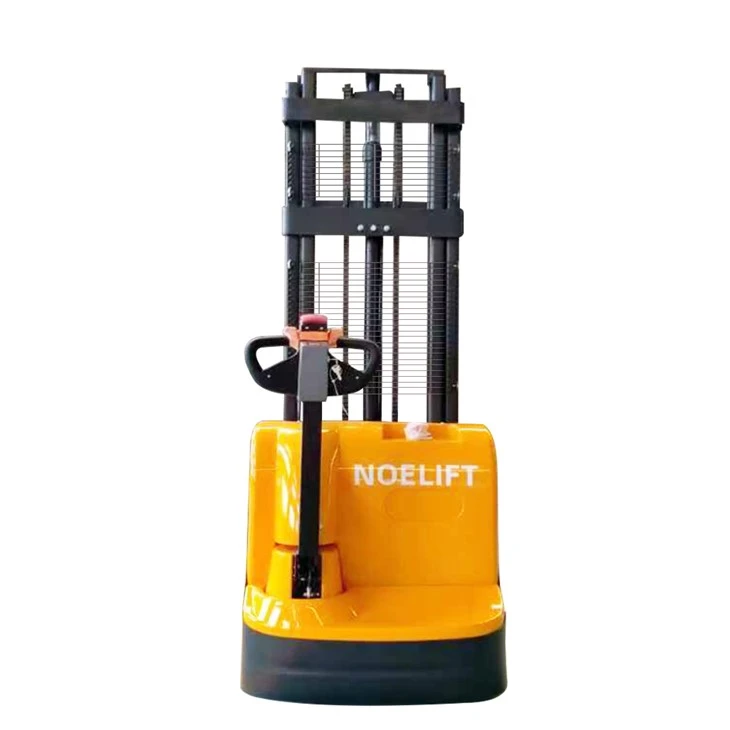
If you're in the market for a walkie type electric pallet stacker, how do you use lift and lower speeds to make your choice? Start by mapping your daily workflow: what's the average weight of your pallets? How high do you need to lift them? How many pallets do you move per hour during peak times? If you answer those, you can narrow down the right speed range. For example, a standard mid-sized warehouse moving 1,000kg pallets to 3-meter heights will be well-served by a full-electric stacker with a loaded lift speed of 0.10 m/s to 0.13 m/s and lower speed of 0.11 m/s to 0.15 m/s. This range balances speed and control, works for most common warehouse tasks, and fits a wide range of budgets.
It's also worth noting that newer models are getting smarter when it comes to lift speeds. Many walkie stackers now have load-sensing technology that automatically adjusts lift and lower speeds based on the weight of the pallet. That means you get faster speeds for light loads (great for order picking) and slower speeds for heavy loads (perfect for safety). If you have a mixed workload, this feature is a game-changer. For example, the Battery Powered Electric Stacker Forklift Pallet Stacker offers this load-sensitive speed adjustment, making it versatile for small to mid-sized warehouses with varied tasks.
Let's address another point: how these speeds compare to other common warehouse lifting equipment, just to give context. A lot of customers cross-shop walkie stackers with forklifts, like the Noelift 1500kg Diesel Hydraulic Forklift With Isuzu Engine, but that's apples to oranges for most indoor applications. Forklifts are built for heavier loads and higher lifts, with lift speeds around 0.12 m/s to 0.18 m/s, but they're bulkier, more expensive, and harder to maneuver in narrow aisles, making walkie stackers the better choice for many spaces. Electric pallet trucks, on the other hand, have no lifting capability at all-they just move pallets horizontally, so they're a separate tool entirely. The Pallet Stacker Hydraulic Flexible Stacker, for context, offers a slightly faster lift speed than a standard walkie stacker, designed specifically for quick, frequent lifting tasks in tight spaces.
Maintenance also plays a role in keeping lift and lower speeds consistent over time. A stacker's hydraulic system needs regular checks: changing the hydraulic fluid every 500 operating hours, checking for leaks, and ensuring the pump and motor are in good shape. Over time, worn hydraulic hoses or a dirty fluid filter can slow lift speeds down, which might make you think you need a new machine when all it needs is a simple service. I always remind customers to include lift speed checks in their regular maintenance schedule, because small issues can turn into big productivity drains if left unaddressed.
If you're still unsure about what speed range is right for your operation, here's a quick checklist to guide you:
- Calculate your average load weight: If most pallets are under 1,000kg, you can lean toward faster lift speeds. Over 1,500kg, go slower for control.
- Measure your typical lift height: Lifting to 2 meters or lower? Faster speeds work. Lifting to 4+ meters? Prioritize stability and controlled speeds.
- Count your daily pallet volume: Moving 50+ pallets per hour? Opt for a model with adjustable speeds to speed up light loads. Fewer than 25? A standard speed range will work.
- Check your aisle width: Narrow aisles (under 2 meters) mean more maneuvering, so slower, more stable lift speeds are safer than faster ones.
At the end of the day, the "right" speed for lift and lower operations isn't a number on a spec sheet-it's a number that fits your team, your space, and your workload. I've seen too many businesses overspend on faster stackers that they don't need, or underspend on slower models that slow down their entire operation. The goal is to find that sweet spot where you can move pallets efficiently, keep your workers safe, and avoid unnecessary wear on your equipment.
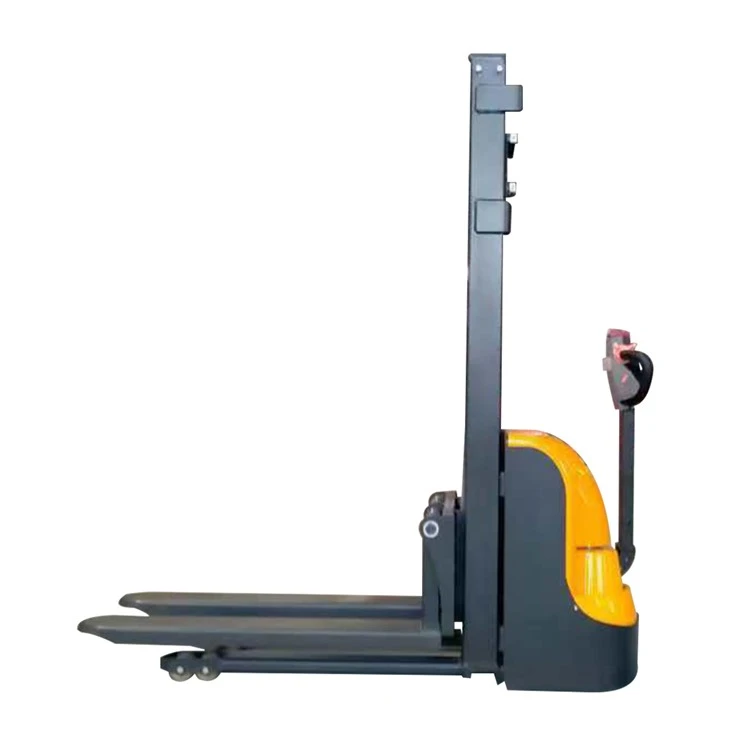
If you're ready to explore walkie type electric pallet stackers that match your specific needs, or want to learn more about how lift and lower speeds impact your daily operations, we're here to help. Our team has years of experience working with warehouses of all sizes, from small retail storage facilities to large distribution centers, and we can walk you through the right model, adjust settings for your workflow, or answer any questions about specs like lift speeds. Whether you're looking for a budget-friendly semi-electric model or a full-featured battery-powered stacker, we have options that balance speed, safety, and durability for every use case.
We can't wait to help you find the perfect walkie pallet stacker to streamline your operations. Reach out today to start discussing your requirements and get a customized solution for your warehouse needs.
References
- Material Handling Industry Association. (2022). Walkie Electric Pallet Stacker Specification Guide. MHIA Press.
- Anderson, L. (2021). Hydraulic System Performance in Warehouse Lifting Equipment. Journal of Industrial Equipment Design, 14(3), 45-52.
- Global Warehouse Equipment Report. (2023). Speed and Safety Standards for Electric Lifting Machinery. Logistics Research Institute.
- Petrov, M. (2020). Balancing Productivity and Safety in Walkie Stacker Operation. Warehouse Management Monthly, 18(6), 12-17.


