

In today's hyper-competitive global business environment, lean supply chain operations have become the cornerstone of a company's core competitiveness. Rising warehousing costs paired with increasingly scarce land resources place immense financial pressure on enterprises. Discovering how to "create unlimited storage value within limited physical space" has become a critical puzzle for modern logistics managers. The emergence of the 3-Way Very Narrow Aisle (VNA) Forklift provides a revolutionary solution to conquer this industry pain point.
1. A Space Revolution: Shrinking Aisles, Doubling Capacity
Traditional counterbalance or reach forklifts are limited by their turning radius, requiring aisles that are typically 3.2 to 3.5 meters wide (or even more). This layout allows massive amounts of prime warehouse real estate to be aggressively consumed by mere "driveways."
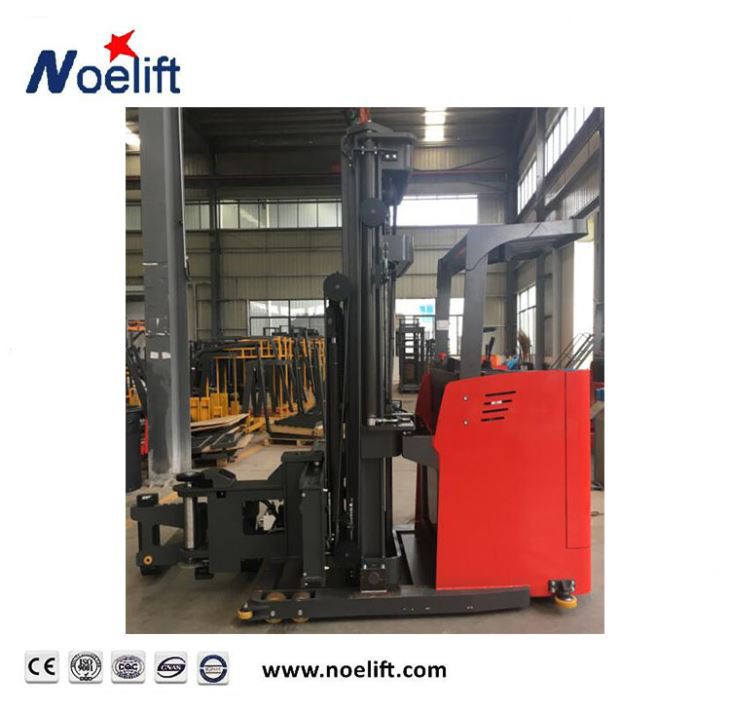
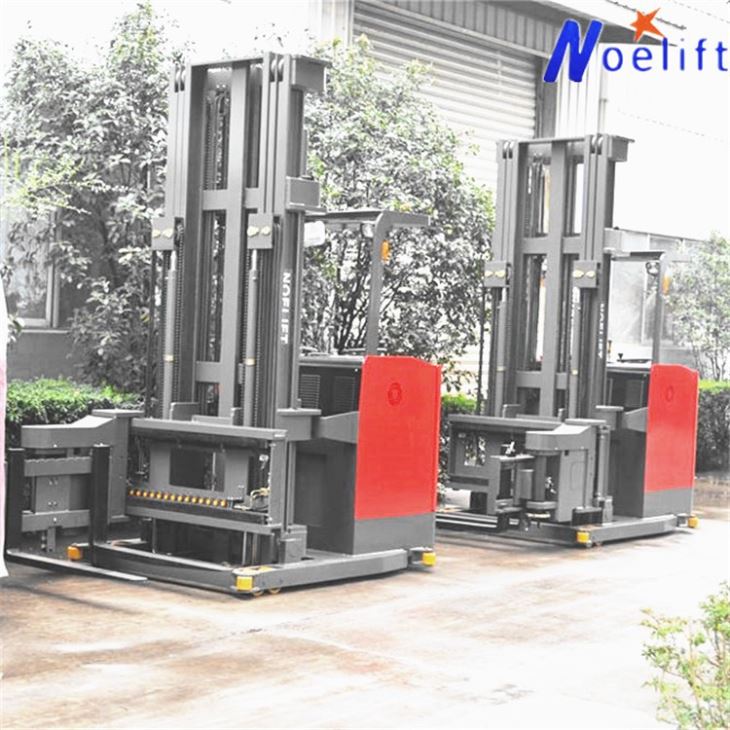
The core technological breakthrough of the 3-way forklift lies in its unique "stationary body, rotating forks" architecture. Its mast and fork assembly can smoothly pivot 180° and shift laterally to either side. This delivers two game-changing advantages:
Very Narrow Aisle Operation: The forklift drives in a straight line through aisles as narrow as 1.5 to 1.8 meters, executing stacking and retrieving tasks on both sides without ever turning the vehicle body.
Leap in Storage Density: According to authoritative industry data, pairing 3-way forklifts with high-bay racking systems can directly boost warehouse space utilization by 30% to 50%. Without expanding the physical footprint or increasing rent, enterprises can double their storage capacity and minimize the storage cost per SKU.
2. Workflow Restructuring: High-Bay Storage Meets High-Efficiency Logistics
From the perspective of professional warehouse layout planning, the space saved by a VNA forklift is not just about raw physical square footage-it optimizes the fundamental operational logic of the entire warehouse.
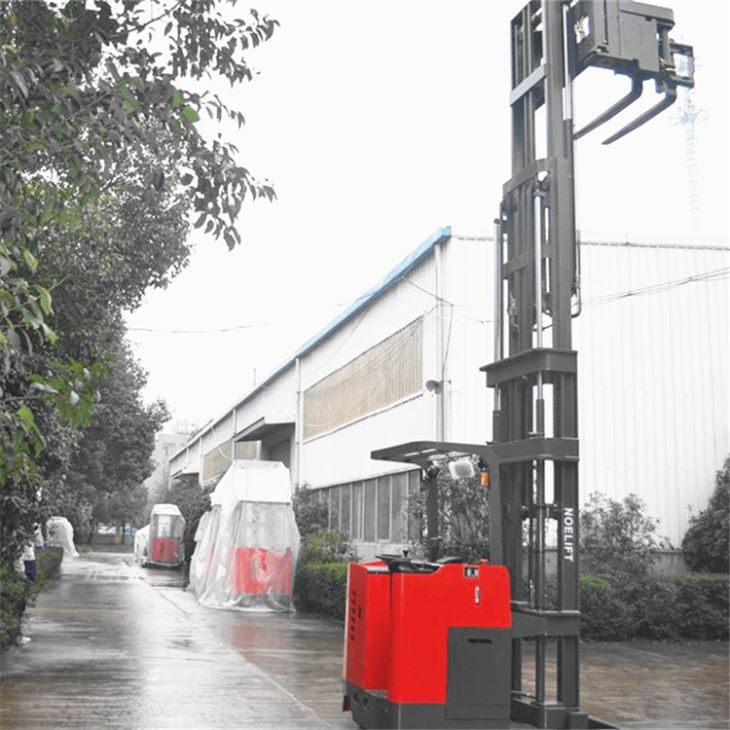
Eliminating Redundant Handling: Due to height and aisle restrictions, traditional warehouses often rely on a "low-level picking, high-level storing" model, requiring goods to undergo multiple drop-offs, transfers, and secondary handling. 3-way forklifts boast exceptional high-lift capabilities (often reaching up to 10 meters or more), enabling seamless, one-stop precision stacking. This drastically slashes handling distances and cycle times.
Optimizing FIFO (First-In, First-Out) Flows: In high-density environments, the lateral flexibility of the 3-way forklift allows Warehouse Management Systems (WMS) to allocate slots more dynamically. This optimizes entry and exit paths, resulting in a substantial spike in overall warehouse throughput and turnover rates.

3. Tech-Driven Safety: Hardcore Defense Systems for Rigorous Work Conditions
Operating at extreme heights within ultra-narrow aisles leaves zero margin for error. To counter potential hazards, modern 3-way forklifts come heavily equipped with top-tier stability and safety systems:
Magnetic/Laser Guidance Systems: Once inside a VNA aisle, the forklift can lock into an automated guidance mode. The operator does not need to steer constantly, as the vehicle moves precisely like it is on rails. This completely eliminates the risk of rack collisions while significantly reducing operator fatigue.
Mast Stability Control & Dynamic Braking: Advanced hydraulic lifting buffers and intelligent balancing systems sense load variations at high elevations in real time. Even when shifting loads laterally at maximum height, the vehicle remains rock-solid, driving cargo damage and accident rates down to near zero. This safeguards personnel and ensures continuous, reliable supply chain operations.
4. Full-Scenario Applications: Empowering Diverse Supply Chains
The robust performance of 3-way forklifts makes them a gold standard for industries demanding maximum space utilization and peak operational efficiency:
Third-Party Logistics (3PL) & E-Commerce: Facing massive SKU counts and peak-season volume surges, VNA forklifts help businesses squeeze every inch of value out of costly urban fulfillment centers.
Cold Chain Logistics: Building and running refrigerated warehouses incurs steep energy costs-often multiple times higher than ambient facilities. Utilizing 3-way forklifts to build VNA cold storage maximizes the refrigerated volume, dropping the cooling energy cost per ton of cargo.
High-End Manufacturing & Auto Parts: For industries requiring precise line-side warehouse management, these forklifts ensure high-density storage and rapid parts picking to feed production lines seamlessly.
Conclusion
In the modern logistics landscape, standing still means falling behind. As the industry accelerates toward automation, high density, and precision, the 3-way forklift has evolved far beyond a basic "handling tool." It has transformed into a strategic asset for space investment and cost control. By maximizing space, restructuring workflows, and anchoring safety with cutting-edge engineering, it is leading forward-thinking enterprises into a higher-dimension, lower-cost era of green logistics.


