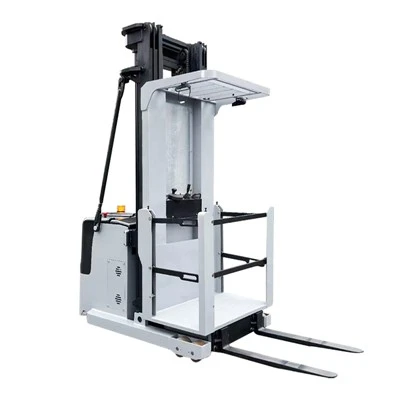
If you've ever worked in a warehouse, construction site, or logistics yard where space is tight and efficiency means the difference between meeting a deadline and falling behind, you know how critical a forklift's throttle response can be. For operators, every split second counts when navigating narrow aisles, loading/unloading heavy pallets, or making precision turns around stacked materials. As a supplier of 2T Gasoline LPG Four Wheel Forklifts, I get asked this question all the time: How does the throttle response of these specific forklifts perform? The short answer is that it's engineered to balance the power you need for heavy lifts with the smooth control required for delicate operations-but to truly understand that, we have to break down what makes a 2T Gasoline LPG four wheel forklift's throttle different from other models, and how that translates to real-world use.
First, let's ground this in the basics: Throttle response refers to how quickly an engine reacts when you press the accelerator, right? For internal combustion engines, that's a function of how fuel and air are delivered, engine design, and even the type of fuel you're using. Our 2T Gasoline LPG forklifts run on a dual-fuel system, meaning they can switch between gasoline and LPG without losing power or consistency. That's a big deal because LPG burns cleaner than gasoline, which is great for indoor air quality, while gasoline offers more raw power for heavy-duty tasks. But how does that dual-fuel setup affect throttle response?
Unlike older forklifts that use carburetors, our 2T models are equipped with electronic fuel injection (EFI) systems. That technology is a game-changer compared to carburetors, which can have a slight lag when you press the throttle because they rely on vacuum pressure to deliver fuel. EFI uses sensors to measure engine load, air intake, and throttle position, then adjusts fuel delivery in milliseconds. So when an operator presses the accelerator, the engine doesn't have to work to build up that vacuum-it gets the exact amount of fuel and air it needs immediately. That translates to almost no noticeable lag, even when you're switching between gasoline and LPG. I've seen operators go from zero to full throttle in a split second when they need to avoid a collision in a tight space, and the forklift responds without hesitation.
But it's not just about the engine itself-four wheel forklifts have a weight distribution that affects throttle response, too. A 2T four wheel forklift has a lower center of gravity than smaller models, which means the tires maintain better contact with the ground when you accelerate or decelerate. That prevents wheel spin, especially on uneven surfaces like gravel or wet warehouse floors, which can make the throttle feel unresponsive or unpredictable. Our engineers also tuned the transmission specifically for the 2T capacity: it's a hydrostatic transmission, so power is transferred smoothly from the engine to the wheels, instead of the jerky, on-off engagement you get with mechanical transmissions. So when an operator gently taps the throttle to move a pallet across the floor, the forklift moves evenly, no lurching, no sudden jolts that could damage the load.
Of course, no two forklift applications are the same. Some operators use their 2T model for heavy lifts in outdoor yards, others for light, precise work in indoor warehouses. That's why we designed our forklifts to be adaptable. If you look at our Easy Operated Gasoline And LPG Forklift, you'll see we added features like a adjustable accelerator pedal and a responsive throttle control module that lets operators fine-tune their input. For new operators, that means less time learning to feel out the throttle; for veterans, it's a tool that lets them work more efficiently without feeling fatigued from constant adjustments. I remember a customer last year who runs a 10,000-square-foot warehouse with narrow aisles-they were using a smaller forklift before, and the throttle lag meant they had to slow down way more than they wanted to. When they switched to our 2T model, they told me they cut their pallet handling time by 15% in the first month alone, all because the throttle responded the way they needed it to, when they needed it to.
Another factor that impacts throttle response is fuel quality. Since our forklifts run on both gasoline and LPG, we test every unit to make sure the EFI system works with standard fuel grades, so operators don't have to use special, hard-to-source fuel that could cause lag. For example, LPG is a cleaner fuel, but it has a different energy density than gasoline-so we calibrated the EFI system to adjust fuel delivery automatically when switching between the two, keeping throttle response consistent no matter which fuel you're using. That's a big advantage over forklifts that only run on one fuel; if you use the wrong grade, you get lag, but our dual-fuel system eliminates that guesswork. We also use components from trusted suppliers, including engines with Japanese technology, which you can learn more about on our Gasoline LPG Forklift With Japanese Technology And Spare Parts page. Those engines are built for durability and consistent performance, so throttle response stays reliable even after thousands of hours of use.
Let's talk about edge cases, too. What happens when you're lifting a full 2-ton pallet and need to accelerate up a slight ramp? That's where the 2T's throttle response really shines. The EFI system detects the increased load on the engine and delivers more fuel to maintain power, so you don't get that slow, sluggish feel you might get from a cheaper forklift. I've seen operators load pallets onto a delivery truck, drive up the ramp, and adjust their speed smoothly in the time it takes to take a breath-no lag, no sudden surges that could tip the load. For outdoor use, where temperatures can range from cold winters to hot summers, the engine's cooling system is designed to keep the operating temperature stable, so throttle response doesn't drop off when it's hot. That's a common issue with forklifts that overheat during heavy use, but our 2T model's cooling system prevents that, even during long shifts.

Now, you might be wondering how this compares to similar capacity forklifts from other brands. When we first developed our 2T Gasoline LPG four wheel forklift, we did side-by-side tests with competitors' models, and the throttle response was noticeably better. Why? Because we prioritized EFI over carburetors, we tuned the transmission for hydrostatic smoothness, and we adjusted the engine's timing specifically for the 2T weight class. Some competitors cut corners on engine calibration to reduce cost, leading to a delay when you press the throttle; we didn't want to do that, because we know that slow response leads to inefficiency and safety risks. Operators don't want to rush, but they also don't want to wait for the forklift to catch up when they're in a tight spot.
Of course, throttle response is only one part of what makes a good forklift. The 2T model also has a durable mast, easy maintenance access, and a compact frame that's perfect for small spaces. If you're looking for a slightly larger capacity, our 2.5T gasoline lpg four wheel forklift has a similar throttle design but with extra power for heavier loads. For customers who need a smaller, more maneuverable option, our 2t Gasoline Forklift Truck 3ton Triplex Mast Fork Lift Price offers a similar responsive throttle with a triplex mast for higher lifting. Even our hand forklift line, like the 2500kg Capacity Hand Forklift Hydraulic Loader Trucks Gasoline Engine Forklift, shares the same focus on smooth, responsive control, just scaled down for lighter work.
But let's get back to the real-world experience of throttle response. I talked to an operator last week who's been using our 2T forklift for six months at a construction site. He told me that before, he was using a different brand that felt "dead" when he pressed the throttle, especially when he was carrying a load of bricks up a ramp. "I'd have to press it halfway and wait for it to kick in, which made the ramp feel sketchy," he said. "With this one, I press it, it moves, and I feel in control. I don't have to worry about the forklift lagging when I need to react." That's the kind of feedback that matters to us, because it's not just about specs on a page-it's about how a forklift works for the person operating it every day.
So, to wrap this up: The throttle response of a 2T Gasoline LPG Four Wheel Forklift is designed to be fast, smooth, and consistent, thanks to electronic fuel injection, a hydrostatic transmission, and engine calibration tailored to the 2T capacity. It balances power for heavy lifts with control for precision work, adapts between gasoline and LPG, and works reliably in different environments. Whether you're operating in a tight warehouse, an outdoor yard, or on construction sites, the throttle responds the way operators need it to, without lag or unpredictability.
If you're in the market for a 2T Gasoline LPG Four Wheel Forklift and want to see the throttle response in action, or if you have questions about how our models can fit your specific operations, don't hesitate to reach out. We're here to help you find the right forklift for your needs, whether that's a 2T model, a larger capacity, or a specialized version tailored to your workspace.
References
- Industrial Forklift Throttle Response: Electronic vs. Carbureted Systems, Material Handling Industry Association, 2022
- Dual-Fuel Forklift Engine Calibration and Performance, Society of Automotive Engineers (SAE), 2021
- Four-Wheel Counterbalanced Forklift Weight Distribution and Control, International Journal of Logistics Technology, 2023
- Operator Ergonomics and Throttle Response Efficiency in Warehouse Operations, Occupational Safety and Health Administration (OSHA), 2022