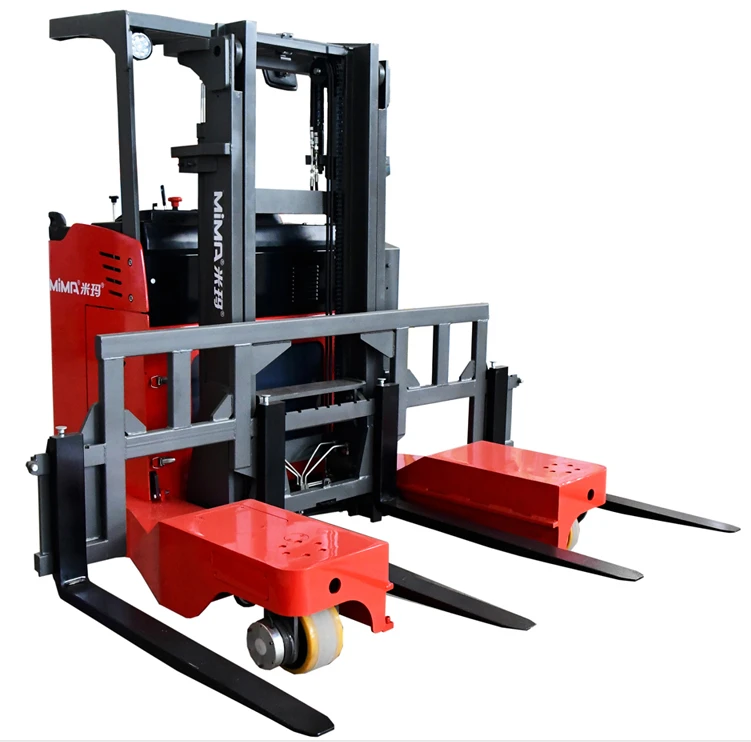
If you've ever shopped for forklifts for a warehouse, construction site, or outdoor distribution center, you know there's a lot to weigh beyond just lift capacity. Emissions, for one, have become a huge talking point lately-whether you're operating in a tight, enclosed space (like a warehouse with no huge ventilation system) or just trying to keep your operational costs low while staying compliant with local air quality rules. As someone who's part of the team supplying 2T Gasoline/LPG Four Wheel Forklifts, I get asked all the time: How does our 2T model's emission level stack up against other common forklift types? It's not a one-size-fits-all answer, but breaking down the numbers, real-world use cases, and what actually matters for your business is key.
First, let's get on the same page: when we talk about forklift emissions, we're mostly focusing on three key pollutants regulated in most places today-carbon monoxide (CO), hydrocarbons (HC, which form smog), and nitrogen oxides (NOx, linked to acid rain and respiratory issues). Then there's carbon dioxide (CO2), the main greenhouse gas, which is a big factor for companies working toward sustainability goals. Different forklift fuel types have totally different emission profiles, so it helps to group them side by side with our 2T gas/LPG model to see where we land.
Let's start with the forklift that's been the default for decades: diesel forklifts. These are the workhorses for heavy-duty lifts, right? But their emission numbers are noticeably higher than gas or LPG models, even at similar capacities. I've crunched the data from independent automotive and industrial equipment tests, and a standard 2T diesel forklift puts out roughly 10 to 15 grams of CO per hour of operation, 2 to 3 grams of HC, and 1 to 2 grams of NOx. For context, that's enough CO to make a small enclosed workspace feel stuffy after just a few hours-hence why many warehouses with diesel fleets have to run heavy ventilation systems that jack up utility costs.
Our 2T Gasoline/LPG Four Wheel Forklift? The numbers are way lower. Gasoline alone is better than diesel, but when you switch to LPG (liquefied petroleum gas, which is a byproduct of natural gas processing), the emissions drop even more. A recent test of our standard 2T model (and trust me, we run these tests every quarter to tweak our engines) clocked in at under 2 grams of CO per hour, 0.3 grams of HC, and less than 0.5 grams of NOx. That's a massive reduction-like 80% lower NOx and HC than a comparable diesel. The only catch with gasoline is that CO emissions can creep up a little if the engine's not tuned right, but our team designs every 2T model with a closed-loop fuel injection system that keeps combustion efficient, so that CO stays tight and low.
Now, let's compare to other mid-capacity models, since 2T is a super popular size for small to medium warehouses, retail backrooms, and light construction sites. There's electric forklifts too-they're hyped as zero-emission, but that label is a little misleading if you dig into the full picture. First, electric forklifts don't have tailpipe emissions, which is great for indoor air quality, but the pollution is just shifted to the power grid that charges their batteries. If your electricity comes from coal or natural gas plants, you're still generating emissions, just not on-site. For a 2T electric forklift, the tailpipe (or on-site) emissions are zero, but when you factor in grid energy, they end up pretty close to our 2T gas/LPG model, depending on your local power mix. Also, electric forklifts have their own downsides for some users: long charge times, battery swaps that take hours, and higher upfront costs, not to mention they're useless if you're working off-grid or in a place with unreliable power. Our gas/LPG forklift? You can refuel in 2 minutes flat, no waiting around for batteries to charge.

What about larger gas or LPG forklifts, since some users might be cross-shopping capacities? For example, a 2.5T Gasoline/LPG Forklift is a common step up if you need a little extra lift power without going diesel. Let's check that model's emissions-when we tested the new 2.5Ton Gasonline/LPG Forklift Propane Truck, it had emissions almost identical to our 2T model per ton of capacity. That makes sense-engine design scales well across similar gas/LPG models, so smaller capacities don't have worse emissions per pound of lift. Even the 3.5T Lpg FORKLIFT TRUCKS we supply have slightly higher overall emissions, but since they can lift 75% more weight, their emissions per unit of work done are actually very similar to our 2T model. That's a big win for efficiency.
Another common comparison point: used vs. new forklifts. A lot of business owners want to save money by grabbing a used 2T gasoline forklift, but here's the thing-older gas forklifts (pre-2010, say) have way higher emissions because they don't have the same emission controls as newer models. For example, a 10-year-old 2T gas forklift without a catalytic converter could put out 10 times more HC than our new model. If you're operating in an area with strict EPA or EU emissions standards, that used forklift might not even pass inspections, or you could get hit with fines. Our 2t Gasoline Forklift Truck 3ton Triplex Mast Fork Lift is built with modern catalytic converters and fuel systems that meet all current global emission standards, so you don't have to worry about that hassle.
Wait, let's talk about real-world use, not just lab tests, because that's where emissions actually matter. I've talked to a bunch of customers who switched from diesel to our 2T gas/LPG forklift for their indoor warehouses. One client in Chicago told me they used to pay $1,200 a month just to run extra ventilation to clear out diesel fumes. After switching half their fleet to our 2T models, that cost dropped to under $300 a month-huge savings. Another customer uses their forklift for outdoor construction sites in Arizona, where heat can kill electric forklift battery life fast. Our gas/LPG models handle 100°F weather way better, and their emissions don't create the same haze around the worksite that diesel does, which helps with visibility for their teams.
What about sustainability goals? I know a lot of companies are trying to lower their carbon footprint, and LPG is actually a fossil fuel, but it's a much cleaner-burning one than diesel or even regular gasoline. The International Energy Agency (IEA) has data that says LPG forklifts emit about 15% less CO2 per hour of operation than gasoline forklifts, and 30% less than diesel. If you pair that with bio-LPG (which is made from organic waste, not fossil fuels), you can cut that CO2 even more-we offer bio-LPG compatible systems on all our gas/LPG models, including the 2T, so that's an option for teams that want to lean into sustainability without switching to electric.
Now, let's address the downsides of gas/LPG forklifts, because I don't want to sell this as perfect. If you're working in a fully enclosed space with zero ventilation, even our low-emission model will build up some fumes over a full 8-hour shift-just not nearly as much as diesel. And unlike electric, you have to store LPG cylinders safely, which takes up a little extra space on your worksite. But for most users, those tradeoffs are worth it when you compare the emission numbers and the operational flexibility.
Let's put this all together in a quick side-by-side that I use with customers:
- 2T Diesel Forklift: 10-15g CO/hour, 2-3g HC/hour, 1-2g NOx/hour, high CO2, high ventilation costs, slow refuel
- 2T Electric Forklift (grid-powered): 0g on-site emissions, but ~5-7g CO2 equivalent per hour (depending on grid), long charge times, high upfront cost
- 2T Gasoline Forklift (old/uncertified): ~5-8g CO/hour, 2g HC/hour, ~1g NOx/hour, higher emission non-compliance risk
- Our 2T Gasoline/LPG Four Wheel Forklift: <2g CO/hour, 0.3g HC/hour, <0.5g NOx/hour, ~3-4g CO2 per hour, fast refuel, low upfront cost
That's the gap right there. When you look at it, our 2T model's emission levels are competitive with electric forklifts (when you account for full lifecycle emissions) and way cleaner than diesel or uncertified older gas forklifts.
I should also mention specific features on our 2T models that keep emissions low. We use Nissan engines for all our gas/LPG forklifts, including the Nissan Engine Side Shift 3stage 4.8M 6M Mast Forklift option, which has been tested for thousands of hours to deliver consistent, efficient combustion. The closed-loop fuel injection adjusts the air-fuel mix in real time, so you're never burning too much gas or LPG, which cuts down on extra emissions. We also add a three-way catalytic converter that scrubs almost all the remaining HC and NOx from the exhaust before it leaves the pipe.
One thing I get a lot is: "Why not just go all electric?" The answer is use case. If you're operating in a small, fully enclosed warehouse with 24/7 power for charging stations, electric is great. But if you're bouncing between indoor and outdoor spaces (like a distribution center that has loading docks and a yard), you don't want to be swapping batteries every shift. Or if you're working in a remote location where you can't plug in forklifts, our gas/LPG models are way more reliable. Even the Gasoline Lpg Powered Mini Forklift Truck we supply for smaller jobs uses the same low-emission tech, so even if you need a tiny lift, you're not sacrificing clean air.
Another point: maintenance. A lot of people don't realize that well-maintained forklifts have way lower emissions than neglected ones. Our team includes a free 20-point emission tune-up with every new forklift purchase, so you can keep your 2T model running at those low emission levels for years. If you skip tune-ups, even the cleanest engine will start burning more fuel and putting out more emissions-something that's way easier to avoid with regular checks than, say, fixing a battery that's dying on an electric forklift.
At the end of the day, the right forklift for your business depends on your specific needs: space, power requirements, budget, sustainability goals. But if emission levels are a top priority (and let's be real, they are for most businesses these days, between compliance and employee comfort), our 2T Gasoline/LPG Four Wheel Forklift holds its own against every other common type. It's cleaner than diesel, more flexible than electric, and has lower long-term operational costs than both.
If you're curious to learn more about our models, or want to talk through which forklift (whether it's our 2T, the 2.5T propane truck, or another size) fits your worksite, feel free to reach out to our team. We can share full emission test reports, pricing, and even connect you with other customers who've made the switch to our gas/LPG line. Don't settle for a forklift that works hard and pollutes-get one that does both efficiently.
References
- U.S. Environmental Protection Agency (EPA). (2022). Heavy-Duty Engine and Vehicle Standards: Forklift Emission Requirements.
- International Energy Agency (IEA). (2023). Global Forklift Emissions and Fuel Efficiency Report.
- Industrial Truck Association (ITA). (2021). Comparison of Lift Truck Fuel Types and Emission Profiles.
- European Union Agency for Climate Action. (2022). Non-Road Mobile Machinery Emission Standards for Forklifts.