

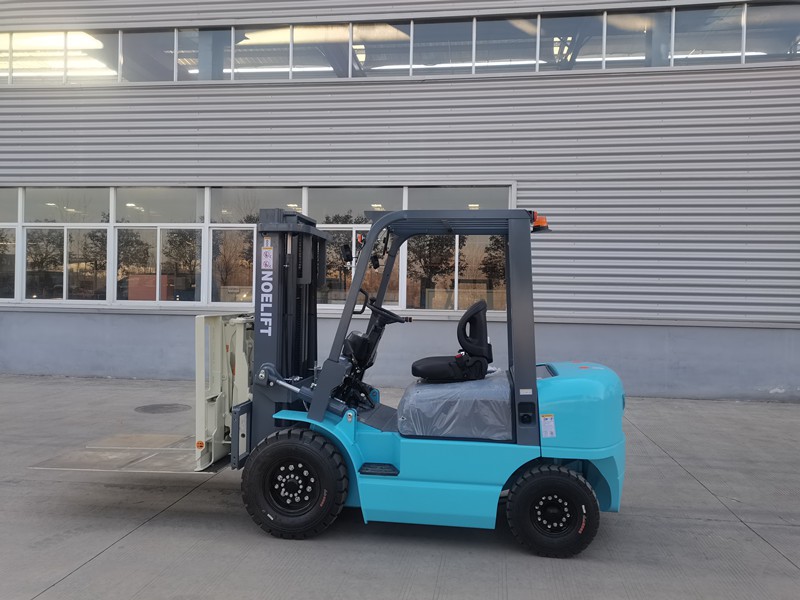
The combustion of fuel in an internal combustion forklift engine takes place inside the engine. The reciprocating piston internal combustion engine converts the explosive pressure generated by fuel combustion into the mechanical power driving the forklift through the reciprocating motion of the piston.
1. Engine type:
According to the different fuels used, internal combustion forklift engines can be divided into two categories: gasoline engines and diesel engines.
1). Gasoline engines generally use a carburetor to mix gasoline and air into the cylinder, and then use an electric spark to ignite and explode to work, so it is called a carburetor engine.
2). Diesel engines generally inject diesel into the cylinder through fuel injection pumps and injectors, and mix with the high-temperature and high-pressure air that has already been sucked into the cylinder (and compressed), causing spontaneous combustion and explosion, so it is also called compression ignition engine
2. The structure of the gasoline engine: it generally consists of the following parts:
(1) Airframe: It is the assembly base of each part of the engine. It includes cylinder head, cylinder block, lower crankcase (oil pan). Together, the cylinder head and the inner walls of the cylinder block form part of the combustion chamber. Many parts of the body are components of other systems.
(2) Crank-link mechanism: It is the mechanism by which the engine generates and transmits power, through which the linear reciprocating motion of the piston is converted into the rotational motion of the crankshaft to output power. It includes piston, piston pin, connecting rod, crankshaft with flywheel and cylinder block etc.
(3) Gas distribution mechanism: including intake valve, exhaust valve, valve lifter, camshaft and camshaft timing gear (driven by crankshaft timing gear), etc. Its function is to fill the combustible mixture into the cylinder in time and discharge the exhaust gas from the cylinder in time.
(4) Fuel supply system: gasoline engine fuel supply system includes gasoline tank, gasoline pump, gasoline filter, air filter, carburetor, intake pipe, exhaust pipe, etc. . Its function is to mix gasoline and air into a suitable combustible mixture and feed it into the cylinder for combustion, and discharge the exhaust gas generated by combustion out of the engine.
(5) Cooling system: mainly includes water pump, radiator, fan, water distribution pipe, cylinder block and water jacket in the cylinder head. Its function is to dissipate the heat of high-heat components into the atmosphere to ensure the normal operation of the engine.
(6) Lubrication system: including oil pump, pressure limiting valve, lubricating oil channel, filter, oil filter and oil radiator, etc. Its function is to supply lubricating oil to the friction parts to reduce the friction resistance between them, reduce the wear of the parts, and partially cool the friction parts and clean the friction surface.
(7) Starting system: including the engine starting mechanism and its accessories.
Therefore, for a gasoline engine, the engine is composed of the above-mentioned two mechanisms and five systems. The composition of the diesel engine is roughly the same as that of the gasoline engine, except that there is no ignition system, and a high-pressure fuel injection pump is added to the fuel supply system.


